

Conversational UX (User Experience) is fundamentally changing how B2B websites operate. It is the shift away from static menus and rigid search bars toward dynamic, chat-driven interfaces powered by AI. Unlike old-school, robotic chatbots that frustrate users with pre-programmed menus, custom AI agents act like your best sales engineers, understanding natural questions and synthesizing real-time answers directly from your company’s approved data.
The digital real estate of the modern enterprise is undergoing a massive transformation. For the past two decades, B2B marketing has relied on what we call the “librarian model.” Marketing teams organize vast amounts of content, whitepapers, pricing pages, compliance PDFs, into neat, hierarchical menus and expect the buyer to do the heavy lifting of navigating the site to find what they need.
This model worked when B2B websites were simply digital brochures. Today, however, enterprise websites are massive, dense repositories of specialized information. As a result, the librarian model has collapsed under its own weight. Buyers simply do not have the patience to dig through your sitemap.
Enter Conversational AI in website development. We are rapidly moving from a world where the user has to learn how to navigate your website, to a world where your website actively adapts to the user’s intent. Let us be clear: this is not about pasting a generic ChatGPT widget onto your homepage. It is about deeply integrating AI into your website’s core architecture to create a frictionless, secure, and highly personalized buying journey.
For Chief Marketing Officers (CMOs) and marketing leaders, this technological shift represents the single greatest opportunity to accelerate pipeline velocity in a decade. In this guide, we break down exactly how to architect, train, and deploy enterprise-grade Conversational UX without compromising brand safety, search engine rankings, or the user experience.
Why B2B Buyers Prefer Conversational Search Over Traditional Website Navigation
To understand why Conversational UX is replacing traditional website navigation, we must look at the friction in the modern B2B buying journey. Today’s B2B buyer is typically a highly educated executive who has zero tolerance for time-wasting digital hurdles.
Consider a typical scenario: an IT Director at a Fortune 500 company lands on your SaaS website. They do not want to read your generic homepage copy. They have a specific, high-intent question: “Does your cloud infrastructure comply with SOC 2 regulations for data housed in the EU, and how does that affect system speed?”
On a traditional website, answering this single question requires the buyer to go on a scavenger hunt:
- Navigate the primary menu to locate the ‘Resources’ tab.
- Filter through a sprawling library to find ‘Compliance Documentation.’
- Fill out a lead-capture form just to download a 40-page PDF.
- Open the document and manually search for the terms “SOC 2” and “EU.”
- Close the document, navigate back to the main site, find the ‘Developers’ section, and read a separate page to figure out the speed implications.
This process takes minutes, disrupts the buyer’s focus, and often results in them abandoning your site entirely to ask Google or an AI tool like Perplexity instead. When they leave your site, you lose the lead.
Conversational AI collapses this entire multi-step journey into a single interaction. The buyer types their complex query into a chat interface, and your AI agent instantly reads the compliance PDF and the technical documentation to generate a precise, accurate answer in seconds.
What is the Zero-Click Expectation for B2B Websites?
The rapid rise of AI search engines has permanently altered what executives expect. They are now conditioned to receive immediate, summarized answers at the top of their search results without having to click through a series of blue links (often called “zero-click” searches). When these buyers arrive at your corporate website, they expect that exact same instant gratification.
Legacy chatbots completely fail to deliver this. Old chatbots operate on rigid decision trees: If user selects A, show response B. When a buyer asks a complex question that spans different topics, like combining a pricing question with a compliance question, the old bot hits a dead end and defaults to the infuriating fallback: “I didn’t quite catch that, would you like to speak to a human?” This creates more friction and degrades trust in your brand.
Modern AI agents, however, understand semantic intent, meaning they understand the context of the question, not just keyword matches. They can remember inputs from three questions ago, cross-reference multiple data points, and generate personalized responses on the fly. This is true Conversational UX: providing a bespoke, concierge-level digital experience for every single visitor, scaled infinitely across your global traffic.
Examples of Conversational UX in Enterprise B2B Companies
To understand what elite Conversational UX looks like in practice, look at how leading B2B technology companies have replaced traditional search with AI:
Stripe (Developer Documentation):
Stripe is famous for its developer resources. However, rather than forcing developers to manually navigate hundreds of pages, Stripe integrated an AI agent directly into their docs. Now, a user can simply ask, “How do I set up a recurring subscription with a 14-day free trial?” Instead of providing a list of links, the AI instantly writes the exact, custom code snippet required, complete with conversational explanations.
Intercom (The ‘Fin’ AI Bot):
Intercom aggressively transitioned away from their own legacy decision-tree bots. They launched ‘Fin,’ an AI agent that reads a company’s entire historical knowledge base. When a buyer asks a highly specific integration question, the agent reads the underlying documentation in milliseconds and writes a bespoke answer, drastically accelerating the pre-sales discovery process.
Glean (Enterprise Search):
Glean acts as a conversational interface that retrieves data securely across a company’s internal apps (Slack, Google Drive, CRM). Forward-thinking CMOs are now building public-facing versions of this exact architecture for their prospects, turning their public website into an intelligent oracle for buyers.
How to Train AI Agents on Company Data Securely Without Hallucinations
The most common fear CMOs have regarding AI integration is brand safety. Marketing leaders worry that an AI agent might inadvertently leak proprietary pricing data, or worse, “hallucinate” (make up) incorrect technical specifications that kill a massive enterprise deal.
These concerns are entirely solvable through modern web architecture, specifically a framework known as Retrieval-Augmented Generation (RAG).
What is RAG (Retrieval-Augmented Generation) in Marketing?
A common misconception is that implementing AI requires “training” a model on your website data in the traditional sense. Building a custom AI model from scratch is exorbitantly expensive and makes it incredibly difficult to update information when your product features change.
Instead, enterprise websites use RAG. Think of RAG like giving the AI an open-book test, but the only book it is allowed to read is your approved marketing material.
As illustrated in the architecture diagram below, this process structurally separates the “brain” (the AI language model) from the “knowledge” (your actual data).
Here is exactly how this flow works to protect your brand:
Organizing the Knowledge:
It takes your entire library of enterprise data, PDFs, whitepapers, website text, and case studies, and converts them into a smart, searchable format (stored in what is called a “Vector Database”).
The User Query:
When a buyer asks a question on your site, the system instantly analyzes the intent behind their words.
Contextual Matching:
The system performs a rapid search within your approved database, locating the exact paragraphs and data points that answer the user’s specific question.
Prompt Injection:
The system takes only your verified data and sends it to the AI (like ChatGPT), effectively adding a strict rule: “Answer the user’s question using ONLY the following approved information. Do not invent answers or use outside knowledge.”
This architecture neutralizes the threat of hallucination. The AI is forcibly restricted to synthesizing the exact context provided by your marketing team. It does not invent answers; it merely formats your verified data into a polite, conversational tone.
How to Integrate Dynamic Pricing (CPQ) into AI Chat Interfaces
For CMOs focused on pipeline generation, the ultimate goal of Conversational UX is integrating complex pricing logic (Configure, Price, Quote, or CPQ) directly into the chat experience. B2B pricing is rarely flat. It depends on variables like user seats, regions, and multi-year discounts.
An AI agent connected to your pricing software can dynamically guide a user through a complex quote. To visualize how this operates behind the scenes without breaking the smooth chat interface, we have mapped out the flow below:
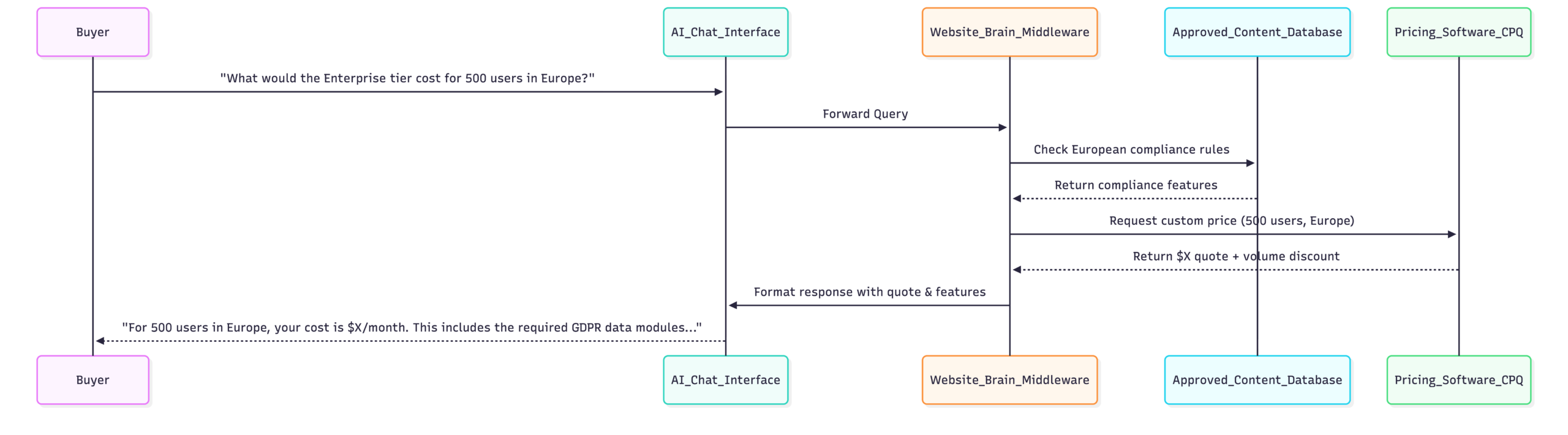
Above: A workflow detailing how an AI Agent acts as a central orchestrator between your approved content and your backend pricing systems.
Instead of forcing the buyer to fill out a “Contact Sales for a Quote” form and wait three days for a rep to email them back, the agent proactively asks qualifying questions, checks the pricing rules in milliseconds, and presents the custom quote conversationally. This removes the highest friction point in B2B marketing: making the buyer wait for pricing.
Website Infrastructure Needed for AI: Monolithic vs. Headless CMS
You cannot build a dynamic, AI-driven future on outdated foundations. Traditional website platforms (like legacy WordPress setups) are often “monolithic”, meaning the backend database (where you write the text) and the frontend design (how the site looks) are rigidly glued together. When marketing tries to bolt an advanced AI agent onto an old monolithic system, it usually results in slow load times and broken pages.
To successfully implement Conversational AI, modern marketing teams are moving their websites to a Headless CMS (Content Management System) architecture.
What is a Headless CMS and Why Does AI Require It?
A Headless CMS (like Contentful or Sanity) separates where your content is stored from where it is displayed. The CMS acts purely as a centralized content hub. It uses APIs (digital bridges that let software talk to each other) to send your text and images to any destination, whether that is your website homepage, a mobile app, or your new AI agent.
This is critical for marketing agility for three reasons:
- A Single Source of Truth:
Your AI agent needs to access the exact same information as your website. In a headless environment, when your marketing manager updates a product feature in the CMS, that change instantly updates on the website text AND within the AI agent’s brain at the same time. There is no manual double-entry required. - Lightning-Fast Speeds:
Conversational UX lives or dies on response time. If a prospect asks a question and watches a loading spinner for 10 seconds, the premium experience is ruined. Headless websites are built on modern frameworks that load almost instantly, keeping the buyer engaged. - Future-Proofing:
Because the content is separated from the design, if you want to redesign your website next year, you don’t have to rebuild your entire content library or retrain your AI.
How Does Conversational UX Impact B2B SEO and Organic Traffic?
A major, valid concern for CMOs is how chat-based interfaces impact traditional Search Engine Optimization (SEO). If buyers are getting answers inside a chat window, how does Google read your site to rank it?
In a modern headless setup, your SEO is fully protected. While the AI agent provides personalized 1:1 chat experiences for active visitors, the headless CMS simultaneously generates standard, lightning-fast web pages for all your content. Google’s search bots can easily crawl and index these pages just like they always have.
Even better, Conversational UX improves your content strategy. The data generated by user queries within the AI chat provides a massive goldmine of actual buyer intent. Instead of guessing what keywords to target, your marketing team can read the exact, specific questions prospects are asking the AI. You can then proactively write dedicated blog posts and landing pages to answer those exact queries, feeding a continuous loop of organic SEO growth.
How Rato Communications Builds AI-Ready B2B Websites
The transition from a passive brochure website to an active, AI-driven revenue engine is a strategic marketing transformation. It requires bridging the gap between compelling brand messaging, rigorous content operations, and elite technical execution.
Many agencies can build a pretty website, and many IT shops can install a basic chatbot. However, very few partners can architect a system where the AI deeply understands your corporate narrative, strictly adheres to brand safety protocols, and actively drives high-value B2B buyers through your sales funnel.
At Rato Communications, we approach your digital real estate as the central nervous system of your entire marketing strategy. Our technical architecture process for CMOs includes:
The Marketing Infrastructure Audit:
Before writing a single line of code, we audit your existing MarTech stack, your content organization, and your website platform to identify what is slowing down your pipeline.
Headless Migration:
We seamlessly transition legacy websites to modern, lightning-fast headless architectures while strictly protecting your historical SEO rankings.
Brand-Safe AI Deployment:
We build isolated, highly secure databases specifically for your marketing content, ensuring your AI only speaks the truth.
Strategic AI Persona Design:
Our content strategists design the behavioral rules that dictate the AI agent’s tone, ensuring it speaks with the exact authority and empathy of your best senior sales reps.
CRM and Pipeline Integration:
We connect your AI agent to your CRM and pricing tools, transforming the chat window from a simple answering machine into a proactive lead-generation engine.
The era of the passive enterprise website is officially over. The B2B brands that win the next decade will be those that offer their buyers an active, conversational, and highly intelligent digital experience that respects their time.
Is your digital marketing architecture ready for the AI revolution?
Do not let an outdated website dictate your revenue ceiling. Evaluate your current web architecture and secure your competitive advantage today.
Contact Rato Communications to schedule a comprehensive infrastructure audit and begin mapping your strategic transition to a Conversational UX ecosystem.