

If you are a Chief Marketing Officer (CMO), you are probably aware that the boardroom conversations have fundamentally changed. The days of presenting a glossy brand narrative and receiving a 10 percent increase in your marketing budget, no questions asked, are over.
Today, you are operating in an environment defined by compressed margins, hyper-scrutinized capital costs, and executive boards that increasingly view the marketing P&L as a prime target for optimization rather than an engine of untouchable growth.
As a CMO, you are intimately familiar with the modern executive mandate: “Do more with less.” You are expected to engineer a 20% increase in qualified pipeline velocity while your overall capital allocation is simultaneously reduced by 15%.
Faced with this macroeconomic pressure, the natural internal instinct is to play defense. Most marketing leaders take last year’s spreadsheet, shave 5% to 10% off every historical line item, pause a few experimental agency retainers, and hope it is enough to satisfy the CFO.
But here is the hard truth: when buyer behaviors are fracturing and AI-driven distribution channels are completely redefining market access, forcing leadership to ask if websites will still be relevant in an AI-driven marketing world, relying on historical spend patterns is equivalent to steering your enterprise by looking exclusively at its wake.
Defensive, incremental budget cuts do not preserve capability; they simply ensure that every single initiative is equally underfunded. To take back control of the narrative, CMOs must shift from a culture of historical entitlement to a culture of absolute financial justification. You must stop playing defense with last year’s legacy spend and start operating like an internal venture capitalist.
This transformation is achieved through Zero-Based Marketing Budgeting (ZBB).
What is Zero-Based Marketing Budgeting?
Zero-Based Marketing Budgeting (ZBB) is a data-driven financial framework where the marketing budget starts from a baseline of zero at the beginning of each fiscal period.
Instead of modifying past expenditures, every campaign, software license, headcount, and agency retainer must be justified from scratch based on its projected return on investment (ROI), pipeline impact, and strategic alignment with corporate revenue goals.
How does it differ from traditional incremental budgeting?
Incremental budgeting assumes that past expenditures are inherently valid, adjusting historical spend upward or downward by a fixed percentage. Conversely, Zero-Based Budgeting rejects historical baselines entirely. ZBB requires marketing operations to reconstruct the budget from the ground up, evaluating every dollar as a fresh capital allocation to eliminate legacy inefficiencies, tech stack bloat, and underperforming marketing programs.
Incremental Budgeting Breed Inefficiency
Incremental budgeting persists within enterprise organizations primarily because it demands minimal thought and avoids inter departmental friction. It allows departments to co-exist without forcing rigorous debates over asset performance or strategic viability. However, this convenience comes at a steep price: the systematic institutionalization of waste and the slow erosion of market competitiveness.
When a B2B marketing organization defaults to an incremental framework, it introduces several structural vulnerabilities into the corporate P&L.
1. The “Use-It-or-Lose-It” Capital Destruction Syndrome
Perhaps the most damaging behavioral byproduct of incremental budgeting is the artificial panic it induces in late Q3 and early Q4. Marketing teams realize that if they do not exhaust their allocated capital before the end of the fiscal year, finance will interpret the surplus as an operational efficiency and permanently lower their baseline budget for the following period.
Consequently, marketing organizations scramble to deploy remaining funds into low-conviction initiatives, rushed ad placements, or speculative sponsorships simply to defend their territory. This pattern represents direct capital destruction, driven entirely by flawed structural incentives rather than strategic intent.
2. The Preservation of “Zombie Campaigns”
Every long-standing enterprise possesses marketing initiatives that operate on autopilot. These are the “Zombie Campaigns”, events, legacy paid search configurations, automated syndication programs, or programmatic advertising plays that were launched years ago to support a specific product launch or corporate initiative.
Over time, corporate strategy pivots, product lines mature, and target audience segments shift. Yet, because incremental budgeting treats the prior year’s baseline as a safe foundation, these legacy line items slip through year-over-year reviews unnoticed. They continue to consume capital and resources simply because no one has been forced to ask: “If we were starting this business today, would we deploy a single dollar into this channel?”
3. Exponential Tech Stack Bloat
The modern marketing technology landscape has transitioned from an era of point-solution experimentation to an era of intense platform consolidation. Despite this, a lack of financial discipline often allows the modern marketing stack to resemble an archival museum of forgotten software purchases.
Under an incremental model, SaaS licenses, point-solution point upgrades, data-provider tiers, and specialized AI-wrapper tools are routinely renewed via automated accounts-payable workflows. Because the base budget is approved en masse, the individual utility of an obscure attribution module or an underutilized content analytics platform is rarely cross-examined against its actual contribution to pipeline velocity.
Operational Vector | Incremental Budgeting | Zero-Based Budgeting |
Baseline Assumption | Past spending is optimal. | Past spending is suspect. |
Resource Allocation | Inertia-driven (Historical) | Strategy-driven (Fresh) |
Tech Stack Discipline | High risk of license bloat. | Mandatory usage auditing. |
Campaign Lifespan | Indefinite (Zombie state) | Bound to performance milestones. |
C-Suite/Board Alignment | Defensive and transactional. | Analytical and transparent. |
4. Disconnect from the Realities of the Modern Buyer Journey
The buyer journey has fundamentally changed. B2B purchasing cycles are increasingly non-linear, self-directed, and insulated from traditional trackable touchpoints. Buyers conduct extensive preliminary research through peer communities, dark social networks, and specialized industry platforms, leaving minimal digital footprints until they are nearly ready to convert.
Incremental budgeting is fundamentally unsuited to this reality. It continues to funnel capital into legacy, high-volume demand-generation mechanisms designed for an era that no longer exists. By breaking away from past spending patterns, CMOs can free up the capital necessary to pivot from high-volume output to a system optimized for AI search, proving that a content strategy is still king: from SEO to Answer Engine Optimization (AEO).
Step-by-Step Framework for Building a Marketing Budget from Absolute Zero
Transitioning an enterprise marketing organization to a zero-based model demands a rigorous, programmatic framework executed with financial discipline. The objective is to build a highly optimized blueprint where every line item connects to a clear corporate revenue driver.
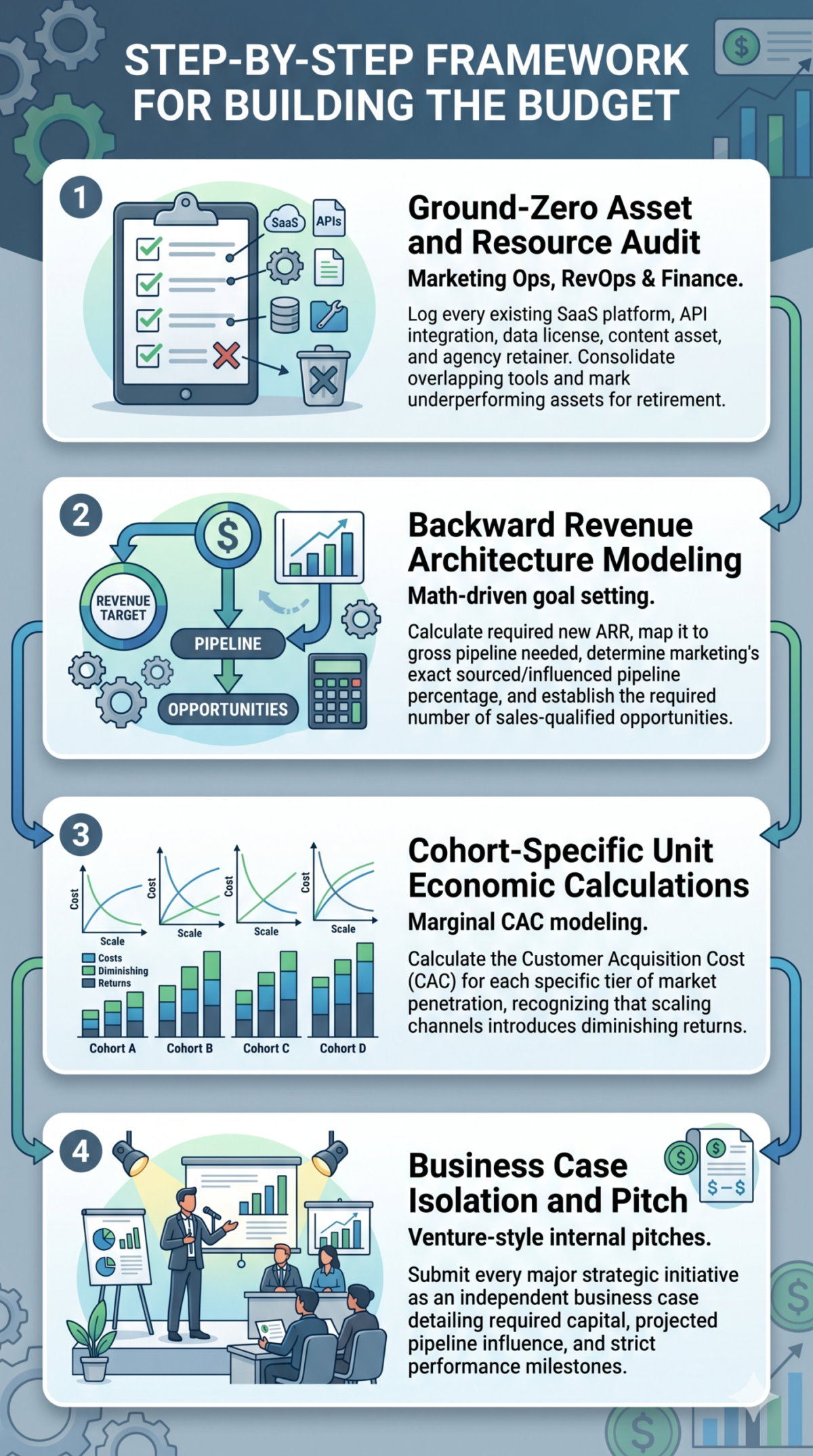
Phase 1: The Ground-Zero Asset and Resource Audit
Before a marketing leader can defend a single forward dollar, they must conduct a thorough inventory of every asset, recurring agreement, tool, and operational activity currently in motion. This requires cross-departmental collaboration between marketing operations, revenue operations (RevOps), and finance.
- The Tech Stack Inventory:
Every SaaS platform, API integration, and data license must be logged alongside its utilization rate, per-seat cost, and contractual renewal date. Tools with overlapping capabilities (e.g., multiple design platforms or siloed email distribution systems across different business units) must be singled out for consolidation. - The Content Infrastructure Assessment:
Rather than measuring content output by volume, teams must evaluate assets based on their performance across the entire buyer journey. Which specific insight reports, architectural content pieces, or case studies are actively contributing to mid-funnel conversion or serving as core references for AI search aggregators? For a deeper dive into constructing these foundational blocks, see our guide on how to build content infrastructure as a strategic marketing asset. - Agency & Vendor Retainer Reviews:
Every external partner relationship must be scrutinized. CMOs must move away from open-ended, loosely defined retainers toward outcome-driven, variable engagement models that tie agency compensation directly to clear milestones, such as pipeline velocity or high-authority brand placements.
Phase 2: Backward Revenue Architecture Modeling
With the baseline cleared, the budgeting process begins not with what marketing wants to spend, but with what the business needs to achieve. This requires backward-engineering the marketing strategy from the board-mandated top-line revenue targets.
Let us look at an illustrative enterprise scenario to see how this architecture translates to specific performance requirements:
- Corporate Mandate: Generate $40,000,000 in new Annual Recurring Revenue (ARR) from enterprise segments.
- Sales Velocity Metrics: Assuming an Average Contract Value (ACV) of $200,000, the sales organization must close exactly 200 new customer accounts. With a historical win rate of 20% from qualified pipeline to closed-won deals, the organization requires a total qualified pipeline value of $200,000,000 (or 1,000 highly qualified opportunities).
- Marketing Contribution Target: If the corporate Go-To-Market (GTM) playbook dictates that marketing is structurally responsible for sourcing 45% of the total pipeline (with the remainder driven by outbound sales development and partner channels), marketing must independently generate $90,000,000 in qualified pipeline value. This translates directly to 450 sales-qualified opportunities.
By establishing these parameters, the marketing organization avoids arbitrary, top-down spending targets. Instead, the team is armed with clear, mathematically validated operational requirements that form the foundation of the zero-based model.
Phase 3: Cohort-Specific Unit Economic Calculations
Once the baseline operational requirements are set, the budget must be built out using precise customer cohort unit economics, rather than generic historical averages.
If the marketing organization targeting a high-value enterprise cohort has a historical Customer Acquisition Cost (CAC) of $15,000across its most efficient channels, that baseline figure cannot simply be scaled linearly across the entire budget. Incremental scale often introduces helical curves of diminishing returns. Instead, the zero-based framework requires calculating the marginal CAC for every expanded tier of market penetration.
By multiplying the targeted volume of opportunities within each specific segment by its calculated unit cost, the marketing team can build an operational budget grounded in clear financial realities rather than historical guesswork.
Phase 4: Business Case Isolation and Pitch
The defining feature of the Zero-Based Budgeting framework is that every major strategic initiative must be pitched as an independent, self-contained business case.
If a marketing director wants to launch a high-authority industry research initiative, they cannot simply bundle it into a general “brand awareness” budget category. Instead, they must submit a rigorous proposal detailing:
- The exact capital expenditure required to produce and distribute the asset.
- The projected influence on organic pipeline velocity and distribution metrics.
- The defensive value of the content asset in securing long-term organic visibility within AI search and Answer Engine Optimization (AEO) environments.
- The clear, measurable milestones that will signal whether the initiative should receive continued funding next quarter or be systematically wound down.
Categorizing Marketing Spend into ‘Keep the Lights On’ vs. ‘Growth Bets’
To implement a zero-based framework without creating operational paralysis, marketing organizations must avoid treating all expenditures as uniform line items. Instead, budgets should be structured around a clear strategic taxonomy, categorizing expenditures into two distinct categories: Keep the Lights On (KTLO) and Growth Bets.
Keep the Lights On (KTLO) [60% – 70%] | Growth Bets [30% – 40%] |
Core corporate web and digital architecture | Greenfield Account-Based Marketing (ABM) |
Foundational Answer Engine Optimization (AEO) | Original research and thought leadership moats |
First-party data integrity and CRM upkeep | Speculative channel and technology testing |
Key customer retention and community programs | Executive personal branding programs |
Keep the Lights On (KTLO): Preserving the Core Infrastructure
KTLO expenditures represent the foundational baseline required to maintain the company’s current market positioning, protect existing pipeline velocity, and support basic operations. These items are still built from zero, but their justification is rooted in business continuity and operational resilience.
- Core Corporate Web and Digital Architecture:
The corporate website is an enterprise’s most valuable digital asset. It is the destination for high-intent buyers and the foundation for all organic visibility. KTLO budgets must cover the necessary engineering, conversion rate optimization (CRO), and security infrastructure required to ensure the site operates at peak performance. - Foundational Answer Engine Optimization (AEO):
In a search landscape increasingly dominated by AI engines, maintaining visibility is an ongoing operational requirement. Foundational AEO involves structuring digital assets, schema markup, and high-value informational content so that the enterprise remains a primary reference point for LLMs and AI search engines. This is not speculative growth marketing; it is essential brand infrastructure. - First-Party Data and CRM Integrity:
Clean, compliant, and highly enriched first-party data is critical for precise modern go-to-market execution. Maintaining CRM infrastructure, marketing automation platforms, and intent-data integrations falls strictly under KTLO. Without this core foundation, all downstream marketing initiatives lose operational efficiency. - Critical Customer Retention Marketing:
Securing existing revenue is often far more capital-efficient than acquiring new logos. KTLO allocations must provide the necessary customer marketing programs, user community infrastructure, and renewal-supporting communications required to insulate the current client base from competitive churn.
Growth Bets: Capturing Alpha and Market Expansion
Growth Bets are proactive, highly targeted capital allocations designed to secure new market share, accelerate pipeline velocity, or establish strong competitive differentiation. These allocations are treated like venture investments within the marketing ecosystem, evaluated on their long-term upside potential, strategic value, and capital efficiency.
- Greenfield Account-Based Marketing (ABM):
Deploying deep, personalized marketing programs into high-value, unpenetrated enterprise accounts requires dedicated resources. These campaigns combine custom content, targeted digital orchestrations, and close sales alignment to break into complex buying committees. - Bespoke Industry Research and Thought Leadership Moats:
To stand out in an AI-commoditized content landscape, companies must invest in original research, proprietary data analysis, and authoritative insights. These investments create content that cannot be replicated by generic text generators, serving as a pillar for corporate storytelling: transforming complex B2B services into compelling narratives. - Speculative Channel and Technology Testing:
A healthy marketing organization must allocate a portion of its capital to exploring emerging distribution channels and advanced capabilities, such as advanced predictive AI modeling or early-stage industry platforms. These initiatives are designed to uncover new avenues for scalable growth ahead of the competition. - Executive Personal Branding Programs:
Modern buyers trust insights from real people far more than generic corporate messaging. Allocating capital to build out the personal brand platforms and thought leadership presence of key internal executives on networks like LinkedIn is an effective way to expand organic reach and establish industry credibility.
Balancing the Portfolio under Economic Constraints
In a balanced B2B enterprise strategy, the capital allocation split typically stays within a 60/40 to 70/30 ratio favoring KTLO infrastructure, depending on the company’s growth stage and risk tolerance.
The value of this clear separation becomes evident during periods of sudden macroeconomic volatility. When corporate mandates require immediate cost containment, executives using an incremental budget are often forced to make blunt, across-the-board cuts that can damage core operational capabilities. In contrast, a zero-based model allows leadership to protect the core KTLO infrastructure while dynamically pausing or adjusting higher-risk Growth Bets based on real-time performance data.
The CMO’s Role in Defending and Optimizing Budget Allocations
Implementing and sustaining a Zero-Based Marketing Budget requires a level of analytical rigor and financial accountability that traditional, execution-focused marketing structures often struggle to maintain. This gap is a primary cause of structural revenue leaks, friction between marketing and sales, and misalignments between the CMO and the CFO. To combat this, enterprise organizations must understand the strategic imperatives behind aligning marketing and sales for predictable revenue growth.
This operational reality explains why a growing number of scaling enterprise organizations are shifting away from bloated internal teams or broad agency setups, opting to weigh agency vs. fractional: choosing the right marketing model to design, defend, and optimize their capital allocation strategies.
Ecosystem Layer | Core Focus | Interaction with the Fractional CMO |
The Board & CFO | Capital efficiency, risk management, and valuation. | Receives fluent financial justification (LTV:CAC, Payback Periods, NPV of Pipeline). |
The Fractional CMO | Strategic oversight, governance, and capital allocation. | Acts as the objective translation layer between corporate finance and creative execution. |
Internal Execution Teams | Campaign deployment, content creation, and lead generation. | Operates strictly within milestone-based guardrails set by the CMO. |
Bridging the Vocabulary Gap Between Marketing and Finance
The tension between the finance department and marketing often stems from a fundamental mismatch in outlook. Traditional marketing reporting frequently emphasizes vanity metrics such as brand impressions, click-through rates, and organic traffic growth. While these metrics matter to execution teams, they carry little weight with a CFO or a Board of Directors focused on capital efficiency, risk management, and overall corporate valuation.
An experienced Fractional CMO with a strong corporate finance background communicates using a completely different set of metrics. They present the marketing budget as a diversified investment portfolio, framing every initiative around metrics that clearly align with broader business performance goals:
- CAC Payback Period by Cohort:
The exact number of months required for a new customer logo to generate enough net margin to recover the initial capital expended to acquire them. - LTV to CAC Ratios:
The long-term relationship between the lifetime financial value of an acquired customer segment and the transactional marketing costs required to secure them. - Net Present Value (NPV) of Marketing Pipeline:
Discounting the projected value of the marketing pipeline based on historical close rates and average sales cycle lengths to present a realistic forward picture of cash flow generation. - Pipeline Velocity Increases:
Measuring the speed at which opportunities move through the revenue engine, demonstrating how strategic marketing initiatives actively reduce sales friction and shorten sales cycles.
Eliminating Internal Politics and Creative Bias
Internal, full-time marketing structures can occasionally develop a natural bias toward self-preservation and budget expansion. Department leaders may associate the scale of their budget and headcount with internal status, which can lean toward defensive thinking when long-standing programs are cross-examined.
A Fractional CMO provides an objective, unbiased perspective to the enterprise. Because they operate independent of internal political dynamics and corporate tenure, they can audit the marketing landscape with absolute neutrality. They do not hesitate to cut underperforming creative projects, eliminate underutilized SaaS tools, or restructure agency agreements. Their priority is singular: aligning every dollar spent with clear, predictable revenue growth.
Implementing Agile Governance and Milestone-Driven Funding
A zero-based budget cannot be a static document approved once a year and left unexamined. It requires continuous, active management. A CMO introduces structured, monthly or quarterly performance reviews to ensure ongoing alignment across all initiatives:
Timeline | Operational Phase | Decision Gateway |
Month 1 | Capital Allocation | Initial funds deployed into an isolated business case. |
Month 2 | Velocity Tracking | Monitoring early leading indicators and pipeline movement. |
Month 3 | Milestone Review | If Target Met: Continue allocation. If Target Missed: Pivot strategy or reallocate capital to KTLO. |
Under this agile governance framework, if a designated Growth Bet fails to hit its pipeline velocity targets within a predefined timeline, the funding is systematically adjusted. The capital is either reallocated to high-performing KTLO infrastructure or returned to corporate reserves. This level of financial discipline gives the Board full visibility and confidence, knowing that marketing capital is being managed with the same structural oversight as any other core corporate asset.
Conclusion
Zero-Based Marketing Budgeting is far more than a tactical exercise in cost reduction; it is a fundamental shift in how modern enterprises manage growth capital. By moving away from legacy incremental frameworks and evaluating every expenditure from absolute zero, B2B organizations can eliminate structural waste, optimize their technology investments, and ensure their strategy matches the real-world habits of modern buyers.
In an environment where market conditions shift rapidly and traditional distribution channels continue to evolve, maintaining financial agility is a clear competitive advantage. Adopting a zero-based model allows enterprise leaders to transform marketing from an unpredictable cost center into a transparent, predictable, and highly disciplined driver of corporate valuation.
Is your organization ready to eliminate hidden revenue leaks, streamline your marketing technology investments, and align your marketing strategy directly with the expectations of the Board?
At Rato Communications, we help enterprise B2B organizations design and implement high-performance go-to-market strategies rooted in deep financial accountability. From building robust content infrastructure and high-authority thought leadership moats to providing experienced Fractional CMO leadership, we ensure every aspect of your marketing spend drives predictable pipeline growth.
Contact Rato Communications to schedule a comprehensive audit of your strategic assets and align your marketing capital with real, predictable revenue velocity.