Every great storyline requires a Storyteller. This is true even for corporate storytelling.
When we analyze the world’s most enduring myths, literature, and cinematic universes, a distinct pattern emerges within the Hero’s Journey. A young, unproven protagonist is thrust into a dangerous new world, utterly unprepared for the trials ahead. But before they can face the ultimate antagonist, they must encounter a mentor figure.
Luke Skywalker had Yoda.
Frodo Baggins had Gandalf.
Katniss Everdeen had Haymitch.
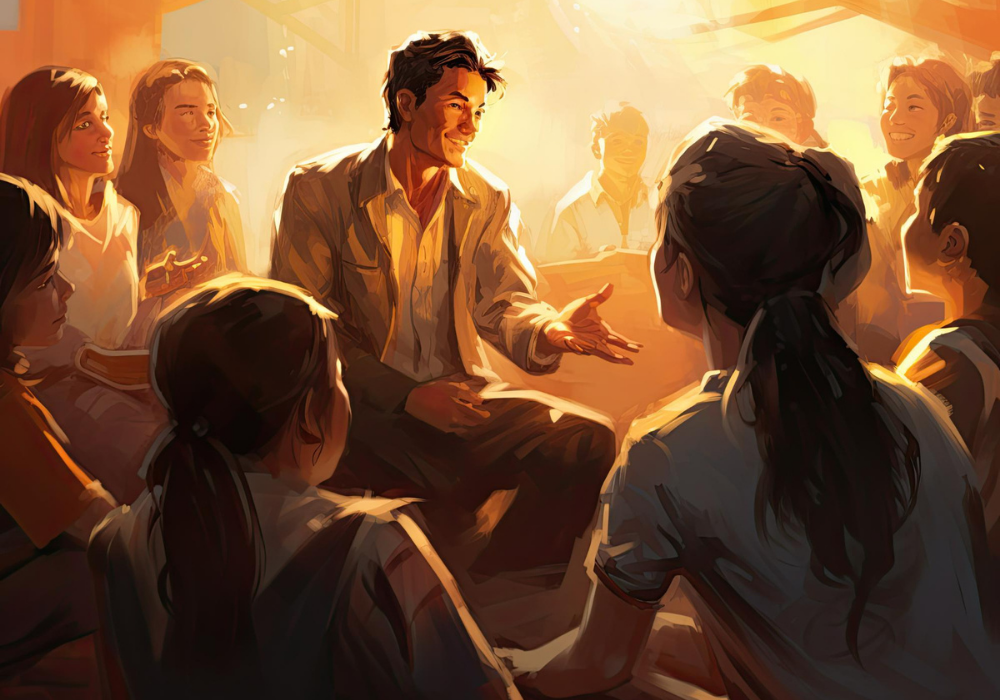
This mentor is usually a skilled Storyteller. They are the archetype who understands the history of the world, knows the dangers that lie ahead, and equips the hero with the knowledge, wisdom, and tools they need to survive the journey. The Storyteller does not fight the battle for the hero, they pass down knowledge, so the hero can fight and win the battle themselves.
In a scaling enterprise, the C-Suite represents the overarching authors of the story. The new hires and frontline employees are the heroes entering the adventure, ready to prove themselves.
The Storytellers? They are your middle managers.
In Part 1 of our Corporate Storytelling Masterclass: Why the Hero’s Journey Requires a Dragon, we explored the danger of the “flawless timeline.” We broke down how sanitizing your corporate history and erasing the struggles, the dragons, destroys company culture and creates a purely transactional workforce. But once you have successfully extracted the unpolished, gritty truth of your company’s history, a new operational challenge emerges: Who is actually responsible for telling these stories to the next generation of employees?
Yet, when organizations attempt to deploy corporate storytelling, this critical narrative link is almost always broken.
Middle managers are rarely equipped to be Storytellers. Instead, they are trained exclusively to be administrators, metric-trackers, and policy enforcers. They are given dashboards, KPIs, and compliance manuals, but they are completely starved of the corporate narrative.
When a new hire asks a vital cultural question, “Why do we prioritize speed over perfection here?” or “Why do we refuse to work with this specific type of vendor, even if they pay well?”, they do not get an inspiring piece of company history. They get a shrug and a response of, “That’s just standard operating procedure.”
This is the exact moment an organization’s culture begins to hollow out. If you want to scale a thriving, resilient company where employees are deeply aligned with the mission and organizational goals, you must transform your middle managers from taskmasters into keepers of the corporate legacy.
The “Curse of Knowledge” in the C-Suite
To understand why middle managers lack the narrative context they need to lead, we must look at the top of the organization. Why aren’t executive teams passing the right stories down to the management layer?
Founders and long-tenured executives suffer from a powerful cognitive bias known in behavioral economics as the “Curse of Knowledge.” Popularized by business researchers Chip and Dan Heath in their book Made to Stick, this bias occurs when an individual communicating with others assumes that the others have the background to understand.
At the executive level, leadership frequently falls victim to the “Curse of Knowledge”, a psychological phenomenon highlighted by Chip and Dan Heath in Made to Stick. This cognitive bias leads seasoned founders and leaders to mistakenly believe that everyone around them possesses the same background context.
Having directly weathered early corporate struggles, founding leaders take for granted that the workforce understands the origin of key policies. For instance, while executives clearly recall the near-fatal crisis a decade prior that necessitated a crucial protocol, they often grow weary of repeating the narrative, wrongly concluding that employees already comprehend it.
As enterprise headcounts expand past several hundred or thousand employees, executive touchpoints naturally diminish. Founders can no longer individually guide every new hire or join every prospective client pitch. Consequently, preserving cultural continuity depends almost entirely on effective communication, making narrative sharing essential.
Because the history is so deeply ingrained in their own minds, they stop telling the stories. They grow tired of hearing their own voices, and they mistakenly assume the workforce already “gets it.”
When organizations expand beyond 500 or 1,000 team members, foundational culture creators naturally become less present in day-to-day operations. Chief executives cannot personally guide every incoming engineer, nor can founders join every sales presentation to model the organization’s relationship philosophy. Consequently, transferring company culture relies almost completely on middle managers.
Without formal documentation of core origin stories from executive leadership and structured training for managers to articulate them, this cultural connection breaks down. New team members enter the organization without guidance, forced to navigate the company culture without a dedicated mentor.
The Solution: Partnering with Storytelling Experts to Extract the Truth
Fixing this disconnect is incredibly difficult for internal HR or communications teams to execute in isolation. Because internal teams are deeply embedded in the day-to-day operations and internal politics, they also suffer from the Curse of Knowledge. They often struggle to identify which stories hold real emotional weight and which are just company jargon.
This is why high-growth organizations partner with external experts to build their corporate storytelling frameworks. By bringing in an objective third party to extract and draft the narrative, companies ensure the story is captured effectively. An external strategist bypasses internal assumptions, utilizing journalistic interviewing techniques with the founders and legacy employees to dig out the “unpolished truth”, the near-misses, the massive strategic pivots, and the triumphs that actually define the company’s DNA.
These experts then structure these raw experiences into a formalized Manager Story Playbook. Instead of leaving managers to guess which histories matter, they are handed a curated suite of narratives perfectly mapped to the company’s core values and organizational goals. To truly build an employer brand that speaks, sticks, and scales, the external partner doesn’t just draft the story; they actively coach the managers on how to retell these critical aspects with confidence and measurable impact.
Embedding Storytelling Across the Employee Lifecycle
Properly empowering leaders and managers transforms corporate storytelling from a soft HR concept into a powerful strategic driver. Embedding these deliberate narratives across each phase of the employee experience ensures maximum organizational alignment and return on investment:
- Onboarding (The Immersion)
Throughout an employee’s initial 90 days, leaders draw from the Story Playbook to establish meaningful context. Prior to detailing how to execute workflows or navigate tools, the Storyteller clarifies why those systems were established, tying daily responsibilities directly to the organization’s overarching heritage. - Talent Acquisition (The Pitch)
Interviewers should leverage narrative techniques during candidate evaluations to distinguish the organization from peers. Rather than merely summarizing benefit plans and salary structures, they recount actual team challenges and triumphs. This approach draws in mission-aligned talent while self-selecting out candidates seeking a low-friction environment. - Town Halls and All-Hands (The Alignment)
When department heads roll out new quarterly OKRs, they do not just show a spreadsheet. They contextualize the new, daunting target by telling a story of how the team conquered a similarly massive goal two years prior. This shifts the mood in the room from anxiety to collective confidence. - Performance Reviews and 1-on-1s (The Coaching)
When a manager needs to correct an employee’s behavior, they bypass punitive corporate jargon. Instead, they share a historical narrative of a similar mistake made in the past, how the company resolved it, and what was learned. This creates psychological safety and corrects behavior without destroying trust. - Offboarding and Alumni (The Legacy)
When top talent leaves on good terms, managers frame their departure as a successful completion of their “tour of duty.” They recount the employee’s specific contributions to the company’s story, turning former employees into lifelong brand ambassadors.
The Mechanics of Story Delivery
Simply handing managers a list of stories is not enough. Experts must train managers on the actual mechanics of narrative delivery. The structure of a great corporate story in a 1-on-1 setting should follow a specific, three-act structure:
The Hook (Setting the Scene In Media Res)
Managers must learn to start in the middle of the action, bypassing boring preambles. Instead of saying, “We value customer service, it’s one of our core pillars,” they learn to say, “Let me tell you what happened three years ago when a massive server outage stranded our biggest enterprise client on Christmas Eve.” This immediately grabs the listener’s attention and anchors them in the reality of the moment.
The Conflict (The Dragon)
The manager must clearly outline the stakes. What was the risk? What would happen if the company failed? “If we didn’t get them back online in four hours, they were going to lose millions in retail sales, and we were going to lose our biggest contract.” This creates the narrative tension required to hold the listener’s focus.
The Resolution (The Lesson)
Finally, the manager ties the historical action directly to the behavior expected of the employee today. “Our lead engineer drove through a blizzard to the data center to physically reboot the servers. We saved the client. The reason I’m asking you to triple-check this deployment code today isn’t because I’m micromanaging you; it’s because of what we learned on that night. We protect the client, no matter what.”
The Neurobiology of Corporate Storytelling
Training managers to use plotlines instead of policies is deeply rooted in human neurobiology. A landmark study published in the Harvard Business Review by neuroeconomist Dr. Paul Zak proved that character-driven stories with a clear narrative arc, specifically those containing conflict, stakes, and vulnerability cause the human brain to synthesize specific, behavior-altering chemicals.
- Cortisol:
The conflict and tension in a story release cortisol in the brain of the listener. This neurochemical forces the listener to pay absolute attention, signaling that the information being shared is highly relevant to their survival and success within the group. - Oxytocin:
The relatable struggles of the characters trigger oxytocin. This chemical directly drives empathetic, trusting, and cooperative behavior. It chemically lowers the listener’s defensive barriers.
Conversely, consider the standard management approach. A perfectly formatted spreadsheet of quarterly projections does not trigger oxytocin. A stern lecture on company policy does not trigger oxytocin. In fact, according to the annual Edelman Trust Barometer, employees are increasingly skeptical of top-down corporate mandates that lack humanity and context.
Data speaks to the intellect, but narrative speaks directly to behavior. When a manager acts as a Storyteller to correct an employee’s behavior, they bypass the employee’s defensive mechanisms and tap directly into their innate human desire for cooperative alignment.
Organizations that aim to sustain their legacy, protect their underlying values, and drive meaningful, long-term business outcomes must actively ensure that their middle managers thoroughly understand the company’s authentic history and are fully empowered with the precise skills needed to articulate it.
As detailed in our foundational framework on how storytelling can save company culture and sustain the legacy, sending middle leaders into high-stakes organizational challenges without narrative preparation inevitably leads to cultural degradation; you simply cannot send your heroes into the wild unequipped and expect them to slay dragons.
Providing managers with structured story playbooks, continuous coaching, and practical frameworks for narrative delivery equips them to systematically translate abstract corporate values into memorable, actionable human experiences across every level of the workforce.
In Part 3 of this masterclass, we will examine what happens when the narrative universe expands. We will explore how CHROs and founders can maintain the plot during the most dangerous organizational inflection points: hyper-growth, M&A crossover events, and generational transitions.