Contact Information
D 203, NR Orchid Gardenia, Mestri Palya, St. Anns Church, Rachenahalli, Bangalore.
P.O.Box: 560077.
Have any Questions?
(+91) 9901765060
Mail us today
connect@ratocommunications.in
In today’s competitive B2B landscape, a strong brand strategy is essential for differentiation and connecting with enterprise clients. This guide for marketing professionals and CEOs offers a ready reckoner to core branding essentials. You will find pragmatic advice to refine brand identity, build decision-maker trust, and stimulate sustained growth, ultimately elevating your brand’s professional standing.
The Brand Pyramid Framework for Strategic Brand Definition
This foundational strategic framework is crucial for businesses to articulate and structure their entire branding strategy clearly and effectively. It functions as a hierarchical system, effectively organising the brand’s key elements, ranging from core beliefs to customer perception, to drive successful brand development and communication.
Core Components of the Brand Pyramid
This framework is built on several interconnected levels, each playing a critical role in shaping the brand’s identity and consumer experience:
Brand Essence: The pinnacle of the pyramid, representing the brand’s fundamental, unique nature and what it ultimately stands for.
Brand Values: The non-negotiable principles that guide the brand’s behaviour, operations, and decision-making processes.
Brand Personality: The set of human-like traits and descriptors (e.g., trustworthy, innovative, adventurous) that humanise the brand and resonate with the target audience.
Brand Promise: A clear, concise statement conveying the consistent expectation and experience customers can anticipate from the brand.
Brand Attributes: The specific, tangible features or benefits that provide concrete evidence and support for the Brand Promise.
Steps for Developing Your Brand Pyramid
To construct a comprehensive Brand Pyramid, follow these essential steps:
Define the Essence: Determine the core identity and singular differentiator of your brand.
Identify Core Values: Establish the guiding principles that govern all internal and external actions.
Articulate Personality: Select the characteristic traits that define how the brand should be perceived.
Craft the Promise: Formulate a compelling statement of what the customer is guaranteed.
Outline Attributes: Specify the features and benefits that substantiate your promise.
By clarifying internal messaging and unifying external communication, the Brand Pyramid is a vital tool for engaging both employees and external stakeholders.
Apple exemplifies an effective use of the Brand Pyramid. Apple’s Brand Pyramid Breakdown:
- Brand Essence (Base): Innovation and simplicity.
- Core Values: Design excellence and a superior user experience, which direct product development.
- Brand Personality: Aspirational and creative.
- Brand Promise: Delivering seamless technology experiences.
- Attributes (Top): Tangible characteristics like sleek design and intuitive interfaces that support the narrative.
Brands that implement a well-defined pyramid typically see greater consistency across their marketing strategies and benefit from enhanced customer loyalty.
It is a common error to view the Brand Pyramid as a static framework. In reality, it must evolve as market dynamics shift and new insights into customer preferences emerge. Regular review and updating of each layer are essential to maintain alignment with current market trends and consumer expectations.
The Brand Wheel Framework for Integrated Brand Identity
The Brand Wheel is a crucial branding strategy model that provides a holistic view of a brand’s perception and the customer experience it delivers. This framework highlights how various brand elements are interconnected, working in synergy to forge a cohesive and powerful brand identity.
Core Elements and Structure of the Brand Wheel
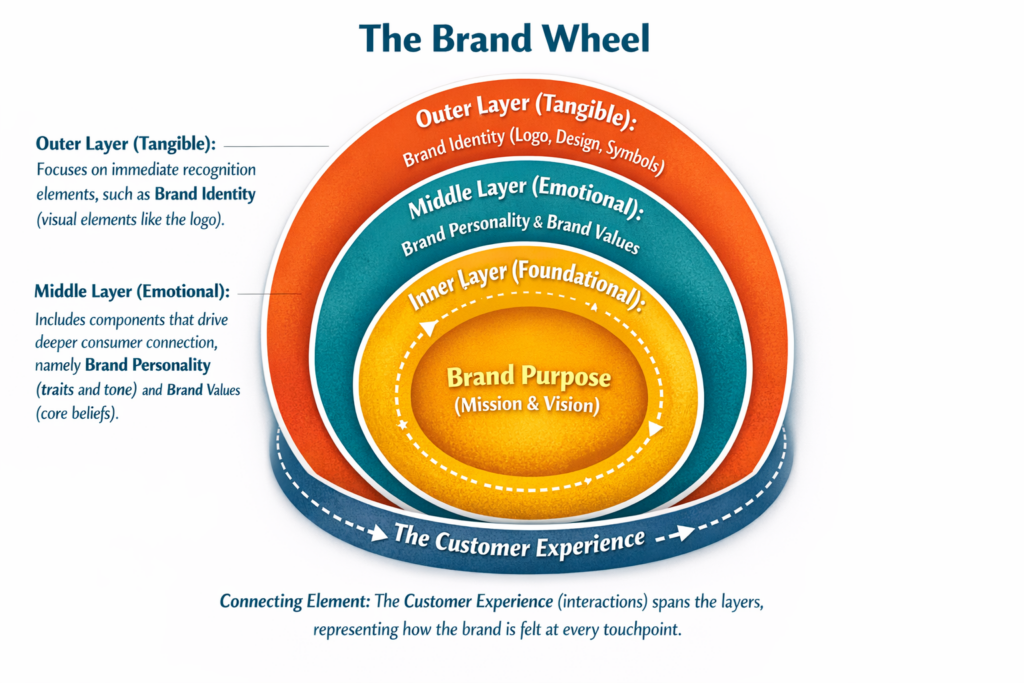
The Brand Wheel is structured in layers, each representing a distinct aspect of the brand, moving from the most tangible to the foundational core:
Outer Layer (Tangible): Focuses on immediate recognition elements, such as Brand Identity (visual elements like the logo).
Middle Layer (Emotional): Includes components that drive deeper consumer connection, namely Brand Personality (traits and tone) and Brand Values (core beliefs).
Innermost Layer (Foundational): Establishes the brand’s blueprint, revolving around the Brand Purpose (mission and vision).
Connecting Element: The Customer Experience (interactions) spans the layers, representing how the brand is felt at every touchpoint.
Effective brand management hinges on understanding the dynamic interaction among these components.
A well-executed Brand Wheel strategy can significantly boost brand equity by ensuring consumer perceptions are in perfect alignment with the business’s strategic goals.
Nike exemplifies a successful Brand Wheel application. Their strategy emphasises athletic performance and empowerment, resonating on both emotional and functional levels. The “Just Do It” slogan perfectly captures this ethos, reinforcing the brand’s purpose while appealing to consumer aspirations. By maintaining consistent messaging across all touchpoints, from product design to marketing, Nike creates a unified experience that strengthens customer loyalty.
The Brand Wheel challenges the common misconception that branding is merely a visual exercise; in reality, it’s about crafting an integrated experience that profoundly resonates with consumer emotions and expectations. It ultimately helps businesses harmonise their marketing strategy with their core values and mission.
However, the framework’s complexity can be a limitation. Brands with an extensive portfolio of products or services may find it challenging to maintain clarity across every component. Poor management can result in mixed messages that confuse, rather than clarify, the brand’s offering to the consumer.
The Value Proposition Canvas for Strategic Branding and Alignment
The Value Proposition Canvas (VPC), by Dr. Alexander Osterwalder, is a proactive strategic tool for brand development, focused on achieving “Product-Market Fit” by aligning a company’s offerings with genuine customer needs. It systematically dissects value into two interconnected parts: the Customer Profile (Circle) and the Value Map (Square).
The Customer Profile requires deep, empathetic understanding:
- Jobs-to-be-Done: Tasks (functional, social, emotional) that customers are trying to accomplish.
- Pains: Negative experiences, frustrations, and risks customers face.
- Gains: Positive outcomes, benefits, and successes customers seek (required, expected, desired, unexpected).
The Value Map details the offering:
- Products & Services: The foundational offerings.
- Pain Relievers: Specific ways the product reduces critical customer pains.
- Gain Creators: Explicit ways the offering delivers the benefits and positive outcomes customers desire.
The VPC’s goal is “Fit,” where Pain Relievers and Gain Creators convincingly address the most important Pains and Gains.
Effective integration requires a methodological approach: Deep Market Research to uncover the why, Mapping and Prioritising customer jobs/pains/gains, Designing and Refining the Value Map to address priorities, and Testing and Validating with real customers.
The VPC is a living, dynamic document requiring constant iteration to maintain relevance. A common pitfall is “Internal Obsession,” where brands focus on their own capabilities over actual customer needs. Successful brands like Airbnb (addressing the desire for authentic travel/pain of impersonal hotels) and Slack (solving the pain of fragmented communication) demonstrate VPC mastery. Ultimately, the VPC shifts focus from selling a product to solving a customer’s problem, driving long-term brand adaptability and success.
Customer Journey Mapping
Customer journey mapping is essential for any effective branding strategy. It provides a comprehensive visual of the entire customer experience with a brand’s offerings, from the initial stage of awareness through to post-purchase engagement. This mapping is vital for identifying friction points, optimising every interaction (touchpoint), and ultimately boosting overall brand engagement.
The Strategic Importance of Customer Journey Maps for Branding
An accurate customer journey map offers critical insights into brand perception and customer expectations. By highlighting areas where customers may experience confusion or difficulty, brands can proactively intervene and resolve issues. Furthermore, understanding the factors that drive customer satisfaction and retention allows brands to foster stronger loyalty.
For instance, Zappos’ success is partly due to its meticulous mapping of the customer journey, from online browsing to the unboxing experience. This focus has enabled them to deliver a seamless shopping experience centred on superior convenience and customer service, which not only provides a competitive edge but also cultivates deep brand loyalty.
Creating an Effective Customer Journey Map
The process involves a structured approach to ensure maximum value:
Define the Target Audience: Clearly outline the audience and their core characteristics.
Identify All Touchpoints: Catalogue every point of interaction a customer has with the brand.
Map the Journey Stages: Sequence the journey from initial awareness through to sustained loyalty.
Gather Experiential Data: Collect customer feedback (via surveys or interviews) on their experience at each touchpoint.
Analyse and Optimise: Use the data to pinpoint opportunities for enhancing engagement and strategic improvements.
The map should be treated as a strategic blueprint for improvement, not merely a documentation exercise.
Starbucks exemplifies excellence in this area. Their mobile app integrates ordering ahead, digital payment, and a rewards system, all of which align with consumer desires for a seamless and convenient experience. By continuously refining this journey based on user behaviour and feedback, Starbucks not only improves service delivery but also significantly reinforces its brand identity.
A well-executed map directly contributes to increased brand equity by ensuring customer perception aligns perfectly with the brand’s business objectives.
It is a common error to view journey mapping as a one-off project. In reality, it requires an iterative approach, revisited regularly to adapt to evolving market dynamics and new insights into consumer behaviour. This continuous refinement ensures the branding strategy remains relevant and responsive.
In essence, a detailed understanding of the customer journey empowers brands to create experiences that deeply resonate with audience needs and desires. Neglecting this crucial process can lead to missing opportunities to build essential emotional connections with consumers, which are foundational to long-term success in a competitive market.
Defining Your Brand: The Positioning Statement
A strong Brand Positioning Statement is the strategic core for all brand initiatives, clearly articulating your brand’s unique market distinction and the specific value it delivers to its target audience. It guides brand management and communication efforts by capturing the brand’s fundamental essence and purpose.
The Anatomy of an Effective Statement
A compelling positioning statement is built on three essential components, ensuring clarity and consistency across all branding touchpoints:
Target Audience: A clear definition of who you are serving.
Unique Value Proposition: What makes your offering stand out from the competition?
Reasons to Believe: Compelling evidence or proof points supporting your unique value.
This concise framework is vital for aligning internal teams and strengthening external messaging.
Crafting a Powerful Positioning Statement
Developing an impactful statement begins with comprehensive market research to understand your audience’s needs, preferences, and pain points. Next, analyse competitors to identify opportunities for differentiation. Use these insights to draft a statement in clear, direct language that highlights your distinct strengths and resonates deeply with the target audience.
Pro Tip:
Always test your statement with real customers to measure its effectiveness before final adoption.
Coca-Cola’s positioning goes beyond a simple beverage, focusing instead on the emotional experience of happiness and shared moments, rather than just product features.
Nike positions itself as a champion of self-improvement and athleticism. The “Just Do It” philosophy inspires consumers to achieve their personal best, extending the brand’s identity far beyond product sales.
Dove’s “Real Beauty” campaign positions the brand as an advocate for diverse and natural beauty standards. By challenging conventional norms, Dove successfully differentiates itself in a competitive market and fosters deep emotional loyalty.
A critical mistake is a statement that is too vague or overly broad; specificity is key to clarity. Ultimately, a brand positioning statement’s strength is its capacity to drive consistency across all customer interactions and marketing campaigns. Brands that deviate from their stated position risk confusing consumers and diluting their core identity.
The Four Pillars of Branding
A strong branding strategy is built upon the interconnectedness of four essential components, known as the Four Pillars of Branding: brand identity, brand purpose, brand experience, and brand communication. Together, these pillars create a unified and compelling narrative that deeply connects with consumers.
Defining the Brand Pillars
Brand Identity: This pillar focuses on the brand’s distinguishing visual and personality traits. It includes critical elements like the logo, colour palette, and typography, which collectively shape the immediate perception of the brand.
Brand Purpose: This defines the core mission, values, and ‘why’ the organization exists beyond generating profit. It is the underlying motivation for all brand actions.
Brand Experience: This encompasses every single interaction a customer has with the brand, from navigating the website to engaging with customer service. It is the total reality of the customer’s journey.
Brand Communication: This involves the strategic dissemination of the brand’s message across various media, including advertising, social media, and public relations. It is how the brand speaks to its audience.
Strategic Application in Brand Development
To effectively implement this framework, follow these strategic steps:
Clarify Brand Identity: Establish a consistent visual system and messaging that accurately reflects the brand’s core values.
Define Brand Purpose: Clearly articulate the brand’s mission to resonate with both internal teams and the external audience.
Optimise Brand Experience: Systematically map the entire customer journey to ensure every touchpoint is aligned with the desired brand perception.
Develop Cohesive Communication: Implement a multi-channel communication plan that maintains a consistent tone and message across all platforms.
It is vital to balance all four pillars, as neglecting any one will result in fragmented and ineffective branding efforts. Furthermore, the pillars are not static; they must continually evolve to remain relevant in response to changing market conditions and consumer expectations. Regular review is essential for sustained success.
Patagonia effectively aligns all four pillars by integrating its commitment to environmental sustainability (Purpose) into its core marketing (Communication). By prioritising its mission over mere product features, Patagonia fosters strong emotional loyalty with values-aligned consumers, solidifying its reputation as a leader in corporate responsibility.
Coca-Cola utilises its instantly recognisable red visual elements (Identity) and its core message of happiness (Purpose). It creates memorable moments for consumers through events and product usage (Experience). This strategy, supported by consistent global messaging (Communication), has secured its status as one of the world’s most recognisable and enduring brands.
Brands that successfully align their strategies across these four pillars consistently achieve greater consumer loyalty and trust.
Emotional Branding: Building Deep Consumer Connections
Emotional branding is a fundamental strategic approach focused on forging profound, emotional bonds between a brand and its audience. This framework highlights the critical role of feelings and experiences in shaping brand perception and driving consumer behaviour. Brands that successfully leverage emotional branding typically achieve enhanced brand loyalty and advocacy.
The Core Concept and Value of Emotional Branding
At its heart, emotional branding delves into the psychological drivers of consumer choices, recognising that purchasing decisions are often fueled more by emotion than by pure logic. For example, marketing from brands like Coca-Cola frequently evokes feelings of nostalgia and happiness, cementing positive emotions tied to shared moments. This strategy not only strengthens brand identity but also fosters a valuable sense of community among consumers.
However, the pursuit of emotional connection must be grounded in authenticity. Brands must genuinely embody the emotions they project; a lack of sincerity is quickly perceived by consumers and can lead to distrust. Therefore, aligning emotional messaging with the brand’s true values is essential for sustained success. Authenticity is key; without it, emotional branding can backfire.
Practical Strategies for Cultivating Emotional Bonds
To effectively implement emotional branding, companies should prioritise compelling storytelling. Crafting narratives that deeply resonate with the target audience creates an emotional link that extends beyond a simple transaction. Nike, for instance, frequently features stories of athletes overcoming challenges, which inspires consumers and positions the brand as a supportive partner in their personal journey.
Another powerful tactic involves designing customer experiences that amplify emotional connections. Brands like Apple create memorable retail environments and product launches that generate excitement and a sense of community among users. Cultivating these positive environments encourages customers to share their experiences, organically boosting brand engagement through word-of-mouth.
Digital Branding Strategies
Digital platforms are no longer a mere extension of branding efforts; they form the bedrock of contemporary brand strategy. For a brand to thrive today, it must utilise digital channels not just for marketing, but for establishing deep, meaningful interactions with its audience. This makes effective digital branding, the holistic online effort to build and maintain a brand’s image, absolutely vital for developing both brand identity and awareness.
Integrating Digital Platforms into Core Branding
Digital branding spans every online touchpoint, from social media engagement to website architecture. The primary challenge is maintaining a cohesive brand image across diverse channels while tailoring content to suit each platform’s unique requirements. For instance, a brand’s presence on Instagram will likely prioritise visual narrative, whereas its LinkedIn content will adopt a more professional and fact-based tone.
Pillars of an Effective Digital Branding Strategy
To successfully execute a digital branding strategy, three essential elements must be consistently addressed:
Authenticity and Transparency: Modern consumers demand that a brand’s messaging directly aligns with its actions. This transparency is a key driver of consumer trust.
Active Engagement: Brands must actively foster a community by engaging with their audience through direct messages, comments, and by integrating user-generated content.
Data-Driven Refinement: Utilising data analytics on user behaviour is crucial for continuously refining strategies and optimising audience targeting.
Brands that prioritise this active digital engagement frequently experience greater customer loyalty and trust.
Lessons from Digital Adaptation and Neglect
Companies that master the digital space, such as Nike, exemplify effective digital branding. Nike builds immersive online experiences that resonate with the aspirations of its consumers. By incorporating user-generated content and authentic stories from real athletes, Nike reinforces its brand authenticity and commitment to community, positioning itself as a leader in emotional branding.
Conversely, the failure of brands like Blockbuster serves as a cautionary tale. Once a market leader, Blockbuster neglected to evolve its brand strategy for the digital age. By underestimating streaming competitors like Netflix, which successfully leveraged digital platforms for brand positioning and consumer connection, Blockbuster demonstrated how resisting digital transformation can lead to the complete erosion of brand equity.
The rapid pace of change in consumer behaviour necessitates that brands continuously innovate their digital strategies; failure to do so risks irrelevance.
Ultimately, successful digital branding requires an ongoing dedication to understanding market shifts and evolving consumer expectations. Brands that embrace this fluidity will not only maintain relevance but also cultivate the lasting connection with their audience that is essential for a robust and enduring branding strategy.
Evaluating and Enhancing Brand Equity
Brand equity, which encompasses elements like awareness, loyalty, perceived quality, and associations, is a crucial measure of how consumers view a brand and its value in the market. Effectively measuring it is fundamental to any successful branding strategy, as it directly impacts a company’s financial performance.
The Role of Metrics and Insights
To properly evaluate brand equity, a combination of quantitative metrics and qualitative customer insights is essential.
Quantitative Metrics:
Net Promoter Score (NPS): Measures the extent of customer loyalty.
Customer Lifetime Value (CLV): Estimates the total revenue a company can expect from a single customer over the duration of their relationship.
Brand Awareness Surveys: Gauge the level of recognition and recall among the target audience.
While metrics like NPS and CLV offer numerical ways to assess customer satisfaction and predict future revenue, relying solely on them can be insufficient.
Qualitative Insights:
Customer feedback provides the necessary context and understanding of the why behind the numbers, offering a complete picture of brand perception.
Guiding Branding Strategy with Data
Metrics act as a vital compass, guiding branding efforts and allowing teams to make informed decisions. They highlight strategic strengths and weaknesses. For example, a drop in brand awareness alongside high loyalty scores might signal that existing, happy customers aren’t effectively driving new customer acquisition.
Brands like Coca-Cola successfully use consumer data analytics to refine their marketing. By studying purchase behaviours and consumer preferences, they tailor advertising campaigns to resonate deeply with specific demographics. This data-driven approach strengthens brand engagement and equity by ensuring their offerings align with consumer expectations.
Common Queries on Branding Strategy
What is a branding strategy?
A branding strategy is a structured plan outlining how a brand will achieve its goals and connect with its target audience. It defines brand identity, positioning, and messaging to create a consistent market perception. Effective strategies focus on understanding customer needs and emotions, not just aesthetics.
Why is a strong brand important?
A robust brand is vital because it fosters consumer recognition and loyalty. A well-defined strategy differentiates your offerings in a competitive market, making your product or service the preferred choice. Companies like Starbucks, for instance, have successfully built a community around their brand identity, which drives customer retention.
How do I choose the right brand strategy framework?
The best framework depends on your specific business objectives and market dynamics. Different frameworks serve unique purposes: the Brand Pyramid helps clarify internal messaging, while the Brand Wheel focuses on external perception. Evaluating your current branding needs against these tools will lead to a more tailored and effective strategy.
Can small businesses benefit from these frameworks?
Absolutely. Branding strategy frameworks provide small businesses with clarity and direction for building awareness without needing large budgets. A local bakery, for example, can use simple frameworks to define its unique selling proposition, ensuring every customer interaction reinforces its brand identity.
What is the role of market research in branding?
Market research is pivotal. It provides crucial insights into consumer preferences, pain points, and the competitive landscape, allowing brands to customise their messaging appropriately. Brands that skip this step often miss key opportunities or fail to align their offerings with market expectations.
How often should a branding strategy be reviewed?
Periodic review is essential for maintaining brand relevance in a dynamic marketplace. Depending on industry shifts and consumer behaviour, an annual or biannual review is advisable. This ensures the strategy and messaging remain current and resonate with contemporary trends, preventing the brand from becoming outdated.
Need help creating a relevant and effective branding strategy? Reach out to us.