Contact Information
D 203, NR Orchid Gardenia, Mestri Palya, St. Anns Church, Rachenahalli, Bangalore.
P.O.Box: 560077.
Have any Questions?
(+91) 9901765060
Mail us today
connect@ratocommunications.in
Think about the last brand you enthusiastically recommended to a friend or colleague.
It may have been a niche software tool that completely transformed your workflow or perhaps a local brand that hits the right spot. What is truly interesting is not the recommendation itself, but how quickly and effortlessly that brand’s name came to your mind.
In a world where consumers are bombarded by non-stop marketing messages every single day, only a rare handful of brands occupy a permanent place in our memory. These brands are not just well-known; they have achieved absolute mental availability. When a specific need arises, they are the default choice.
This is not accidental.
Memorable brands are built on a profound understanding of human psychology, how people feel, think, process information, remember, and seek belonging. According to Harvard Business School professor Gerald Zaltman, up to 95% of purchasing decisions happen subconsciously. This staggering statistic reveals a hard truth for modern businesses: brands do not win in spreadsheets, feature comparisons, or logical debates.
They win in the mind.
Memorable brands do not just sell products; they hack our cognitive biases. By leveraging psychological principles like Cognitive Fluency (making things easy to process), Brand Archetypes and Personality (tapping into unconscious desires), and the Mere Exposure Effect (building trust through repetition), industry leaders bypass our logical brains. They connect directly with our emotions, transforming casual buyers into lifelong advocates.
What Makes a Brand Memorable?
A brand becomes memorable when it successfully bypasses the brain’s logical filters and consistently triggers the subconscious.
This connection is not accidental; it is the result of a deliberate and strategic combination of psychological levers. Unforgettable brands master these five interconnected pillars:
Strong Emotional Associations: The Catalyst for Deep Recall
Moving beyond functional benefits, highly memorable brands connect their product or service to a fundamental, core human desire, such as security, belonging, freedom, or self-actualization. This emotional resonance acts as a powerful mnemonic device. When a brand successfully taps into an aspiration or solves an underlying anxiety, the resulting emotion, whether joy, relief, or inspiration, forms a durable neural pathway. This ensures that the brand is not merely remembered as a product, but as an experience or a solution tied to a personal, meaningful feeling.
Distinctive Visual Identity: The Gateway to Instant Recognition
The most enduring brands minimize the cognitive effort required for identification. They utilize visual assets, specific color palettes, unique shapes, and logos that are so distinct and consistently applied that the brain processes them instantly, requiring virtually zero conscious thought. This visual shorthand creates a powerful mental fingerprint. A memorable visual identity avoids trends, stands out clearly from competitors, and ensures that the brand is effortlessly retrieved from memory, often even before the product name can be consciously recalled.
A Clear Brand Personality: Humanizing the Corporate Entity
Consumers naturally relate to entities that possess human-like qualities. Unforgettable brands define and maintain a clear, consistent, and relatable personality, be it witty, reliable, adventurous, or sophisticated. This defined character allows the brand to “act human” rather than merely “exist corporate.” This personality informs all communications, from customer service tone to advertising copy, fostering a sense of kinship and predictability that builds trust. When a brand acts like a consistent, trusted friend, it secures its place in the consumer’s inner circle of preferred mental models.
Impactful Storytelling: Framing the Consumer as the Hero
The most impactful brand stories are not self-aggrandizing narratives about the company’s history or products; they are focused on the consumer’s journey. By framing the consumer as the protagonist and the brand merely as the essential guide or tool (the Yoda to the consumer’s Luke Skywalker), the brand reinforces a sense of personal meaning and agency. This narrative structure deepens the emotional investment, transforming a simple purchase into a significant step in the consumer’s personal narrative. The story’s consistent theme and moral are easily recalled because they directly relate to the consumer’s aspirations and challenges.
Repeated Exposure Across Touchpoints: Cultivating Inherent Trust
Memorability is not achieved in a single exposure but is cemented through relentless, high-quality, and harmonious consistency across every single touchpoint, from digital advertising and packaging to in-store experience and post-purchase follow-up. This omnichannel coherence leverages the psychological principle of mere-exposure effect, where repeated, positive interaction builds inherent familiarity and trust. This consistency signals reliability to the subconscious, gradually transforming simple recognition into automatic, unquestioning preference.
The Core Drivers: Why Some Brands Stay in Our Minds
Human memory is incredibly selective. From an evolutionary standpoint, our brains are designed to conserve energy. We simply do not remember everything. We remember what stands out, what repeats, and most importantly, what makes us feel something.
Three core psychological drivers shape brand recall:
Emotion: Makes experiences deeply meaningful and tags them for long-term storage in the brain.
Distinctiveness: Helps brands stand out against a backdrop of infinite digital noise.
Repetition: Reinforces neural pathways, turning a novel concept into a trusted memory.
This is precisely why legacy brands invest hundreds of millions of dollars into consistency. The specific hex-code red of Coca-Cola. The stark, breathable minimalism of Apple. The bold, aggressive typography of Nike. Over time, these visual and emotional cues become cognitive shortcuts in the brain.
To understand how to build these shortcuts, we must look at the battleground where these decisions are made.
The Battle of Two Brains: System 1 vs. System 2 in Branding
If you are trying to out-feature or out-logic your competitors, you are fighting a losing battle. To understand why, we have to look at how the human brain processes decisions.
In his groundbreaking book Thinking, Fast and Slow, Nobel Laureate Daniel Kahneman divides human thought into two distinct operating systems:
System 1 (The Autopilot): Fast, automatic, frequent, emotional, stereotypic, and unconscious. This system handles immediate reactions, like jumping when you hear a loud noise, recognizing a friend’s face, or feeling a sudden craving when you see the McDonald’s golden arches.
System 2 (The Pilot): Slow, effortful, infrequent, logical, calculating, and conscious. This system is activated for complex tasks, like parallel parking, doing your taxes, or comparing the technical specifications of two B2B software platforms.
The most common mistake companies make is building their brand for System 2. Marketers love to list features, highlight competitive pricing, and provide deep ROI calculations. They assume the buyer is a highly rational actor carefully weighing their options. However, cognitive science proves the opposite. Because System 2 requires an immense amount of caloric energy to run, the brain defaults to System 1 whenever possible.
If you are forcing your customer to calculate why you are the best, you have already lost the branding war. Memorable brands bypass the friction of System 2 and speak directly to the emotional autopilot of System 1.
Let’s look at Michelin Tires. If Michelin appealed to System 2, their marketing would focus on tread depth, rubber compound durability, and braking distance metrics. Instead, their iconic campaigns famously featured babies sitting safely inside tires with the tagline, “Because so much is riding on your tires.” Michelin bypassed the logical brain entirely and targeted a primal System 1 emotion: the biological drive to protect our children. They aren’t selling rubber; they are selling peace of mind.
Cognitive Fluency & Visual Memory: Why the Brain Rewards Simplicity
At its core, cognitive fluency is a measure of how easy it is for our brains to process information. Psychological studies consistently show a fascinating cognitive bias: the easier a stimulus is to process, the more positively we feel about it.
We subconsciously equate simplicity with familiarity, truth, and safety. Conversely, if something is difficult to read, pronounce, or understand, our brains flag it as risky, untrustworthy, or simply “too much work.”
Visuals are processed by the human brain 60,000 times faster than text. That is why logos, colors, and typography become the most powerful memory anchors a brand can possess. The golden arches of McDonald’s don’t need an explanation; they are instantly recognized across languages and borders.
Example: The Apple Effect
Consider Apple. Their mastery of cognitive fluency is why they are one of the most memorable brands in history. Everything they do is engineered to reduce cognitive load:
Visuals: Vast amounts of white space, clean lines, and a simple, highly recognizable logo.
Copywriting: Punchy, straightforward headlines (e.g., “Pro cameras. Pro display. Pro performance.”) instead of dense technical jargon.
Product Architecture: Naming conventions that are instantly understandable (iPhone, iPad, Mac) rather than complex alphanumeric strings.
Stop confusing complexity with value. If your brand requires a user manual or a massive block of text to explain, you aren’t demonstrating expertise; you are building a barrier.
The Role of Emotion: Why We Buy With Our Hearts
Emotion is the absolute strongest driver of human memory. When the brain processes highly emotional stimuli, it activates the amygdala, the almond-shaped mass of gray matter inside each cerebral hemisphere. The amygdala acts as a biological highlighter, communicating with the hippocampus to strengthen memory encoding.
Simply put: if your brand doesn’t trigger the amygdala, your audience will forget you the moment they scroll past your ad.
This is why emotional campaigns vastly outperform rational ones. The Institute of Practitioners in Advertising (IPA) conducted a massive study on marketing effectiveness and found that campaigns leaning on emotional appeal significantly outperform purely rational, logic-based campaigns in long-term profitability and brand recall.
Brand Personality & Archetypes: Making Brands Feel Human
Long before modern marketing existed, Swiss psychiatrist Carl Jung identified what he called the “collective unconscious” , a set of universal, mythic characters and themes that humans inherently recognize across all cultures and eras. He called these characters archetypes.
Whether it is the brave warrior, the nurturing mother, or the rebellious outlaw, our brains instantly understand these personas without needing an explanation. Memorable brands do not invent new personalities; they adopt an existing archetype and embody it flawlessly.
A brand without a clear archetype is just a commodity. Consumers don’t buy what you do; they buy the story you help them tell about themselves. If your customer cannot instantly recognize your brand’s “character,” they will struggle to build an emotional connection with it.
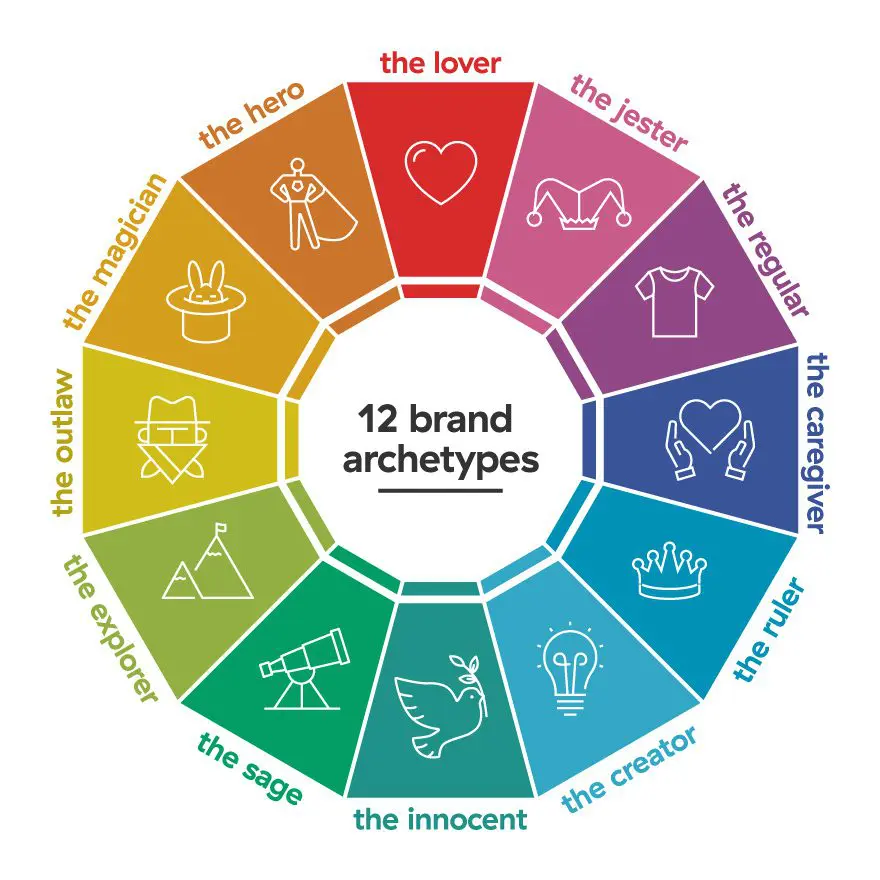
The 12 Archetypes in Action
When a brand aligns with an archetype, its messaging becomes consistent, recognizable, and deeply resonant. Let’s look at how the world’s top brands utilize Jungian psychology to drive loyalty:
The Hero (Mastery & Courage): Nike is the quintessential Hero. They don’t sell shoes; they sell triumph over adversity. Their “Just Do It” slogan is a battle cry, positioning the customer as the hero overcoming their own laziness or physical limits.
The Outlaw (Rebellion & Liberation): Harley-Davidson appeals to the desire to break the rules. Their brand is built on leather, loud engines, and the open road. You don’t buy a Harley for practical transportation; you buy it to signal that you don’t conform.
The Innocent (Purity & Simplicity): Dove built a multi-billion dollar empire by rejecting the highly manufactured, hyper-sexualized marketing of the beauty industry. By championing “Real Beauty” and simple, pure ingredients, they tap into the Innocent archetype’s desire for honesty and wholesome safety.
The Sage (Wisdom & Truth): Think of brands like Google, MIT, or even AI engines like Perplexity. The Sage brand exists to understand the world and share that knowledge, appealing to the consumer’s desire for competence and insight.
The Explorer (Freedom & Discovery): Jeep sells the promise of untamed territory. Their vehicles are positioned not just as transport, but as passports to the wild. They appeal to the consumer’s deep-seated need to break free from the mundane and discover the unknown.
The Creator (Innovation & Expression): Lego champions imagination and building something from nothing. They don’t just sell plastic bricks; they sell limitless creative potential, empowering the consumer to be the architect of their own world.
The Ruler (Control & Prestige): Rolex doesn’t sell timekeeping; they sell status, exclusivity, and supreme power. By aligning with high-achievers and luxury, they appeal to the consumer’s desire for absolute industry dominance, stability, and prestige.
The Magician (Transformation & Vision): Disney is the ultimate Magician. They sell the feeling that dreams come true. From their theme parks to their movies, they promise a transformative experience that takes the consumer from ordinary life into a world of pure wonder.
The Lover (Intimacy & Connection): Chanel focuses on aesthetic pleasure, romance, and sensual connection. They don’t just sell perfume or fashion; they sell the feeling of being desired, elegant, and irresistibly attractive to others.
The Caregiver (Service & Protection): Volvo built its entire brand legacy on one word: safety. They don’t sell horsepower; they sell the ultimate protection for your family, tapping into our deepest biological drive to nurture and shield our loved ones from harm.
The Jester (Joy & Humor): Old Spice reinvented its legacy brand by fully embracing the absurd. They use surreal humor and self-awareness to entertain. They aren’t selling deodorant logically; they are selling a quick hit of joy, irreverence, and living in the moment.
The Everyman (Belonging & Equality): IKEA champions democratic design. They sell functional, affordable furniture for the masses. Their archetype appeals to the desire to fit in, be practical, and live a normal, comfortable life without pretension or elitism.
How to Find Your Brand’s Archetype
To anchor your brand:
- Identify your customer’s core desire: Do they want to feel safe (The Caregiver), powerful (The Ruler), or entertained (The Jester)?
- Pick one archetype: Do not try to be the Hero and the Jester simultaneously. Choose one lane and let it dictate your copywriting, visual design, and product development.
- Make the customer the main character: Your brand is the supporting cast, the mentor or the magical tool that helps the customer live out their archetype.
People relate to personalities, not faceless corporations. To build a memorable brand, you must give it human characteristics.
Brand Personality
The modern marketplace is saturated with products and services, making the task of standing out increasingly complex. However, the most successful and memorable brands achieve this by transcending their functional attributes and adopting a distinct, human-like Brand Personality. This psychological technique makes a brand relatable, predictable, and, most importantly, unforgettable.
Psychologist Jennifer Aaker’s foundational work provides a clear framework for understanding these personalities, defining five core dimensions that allow consumers to connect with a brand on an emotional level:
Sincerity
This dimension embodies traits like being Down-to-earth, Honest, Wholesome, and Cheerful. Brands that align with Sincerity are often seen as trustworthy, dependable, and family-oriented. They evoke a sense of warmth and simplicity.
Examples: Campbell’s Soup (comfort and tradition), Patagonia (environmental honesty and wholesomeness). A Sincere brand feels like a trusted friend or neighbor.
Excitement
Defined by being Daring, Spirited, Imaginative, and Up-to-date. Brands with high Excitement are often innovators, rule-breakers, and energy boosters. They appeal to consumers’ desire for novelty and thrill.
Examples: Red Bull (high energy, extreme sports), Tesla (futuristic, disruptive technology). An Excitement brand is a charismatic trendsetter.
Competence
This personality is built on a foundation of being Reliable, Intelligent, and Successful. Competent brands convey a sense of mastery, efficiency, and safety. They are the experts consumers rely on to deliver on their promises.
Examples: Microsoft (professionalism, technical superiority), Volvo (safety, engineering excellence). A Competent brand is a reliable authority figure.
Sophistication
Characterized by being Upper-class and Charming. Brands in this dimension project prestige, elegance, and exclusivity. They appeal to the aspirational side of consumers, suggesting a refined taste and elevated status.
Examples: Rolex (luxury, timeless craftsmanship), Mercedes-Benz (status, premium design). A Sophisticated brand is an elegant, high-status icon.
Ruggedness
Encompassing traits like being Outdoorsy and Tough. Rugged brands are seen as strong, durable, and authentic, often associated with nature, resilience, and challenging conditions. They speak to the consumer’s desire for freedom and endurance.
Examples: Jeep (adventure, all-terrain capability), Harley-Davidson (rebellion, open road freedom). A Rugged brand is an authentic adventurer.
These five dimensions are the first step in granting a brand a human-like, memorable face. But for a brand to achieve true longevity and deep consumer loyalty, it must often combine this personality with a deeper, mythological narrative.The Integration with Brand Archetypes
To take brand memorability a significant step further, the most unforgettable brands map these personality dimensions to Carl Jung’s Brand Archetypes.
When a brand successfully aligns a specific personality dimension (Aaker’s framework) with an underlying mythological archetype (Jung’s framework), it builds a deeply cohesive and resonant identity. This integration taps into the collective unconscious, making the brand’s narrative instantly recognizable and emotionally powerful.
The ultimate psychological outcome of this strategic alignment is that Consumers don’t just buy the product; they buy the identity. The purchase becomes a symbolic act, a public declaration of the consumer’s alignment with the brand’s narrative, values, and tribe.
For instance, when a consumer purchases a Jeep, they are not merely acquiring a four-wheel-drive vehicle; they are instantly “joining” a rugged, adventurous tribe defined by the Explorer or Outlaw archetype, reinforced by the brand’s Ruggedness personality. The product serves as the physical manifestation of a psychological identity the consumer wishes to embody. This transference of identity is the core mechanism by which functional products become enduring, emotionally-charged, and ultimately, unforgettable brands.
Storytelling: The Ultimate Cognitive Shortcut
Stories are the native language of the human brain. We use narratives to process the world, understand danger, and share knowledge. When a consumer reads a list of facts, only the language-processing centers of their brain light up. But when they hear a story, their sensory cortexes fire as well. The brain experiences the story as if the person were living it.
This makes storytelling the ultimate cognitive shortcut for brand recall.
Example: Airbnb
Airbnb does not sell short-term rental logistics or hotel alternatives. They sell belonging. Their entire narrative is built around the idea that you can go anywhere in the world and not just visit as a tourist, but live there as a local. That shift, from a functional transaction to a deeply human story is what builds unbreakable memory.
If you want to master this, your brand strategy must place the customer, not your company, as the hero of the story. Your product is simply the magical tool that helps the hero achieve their goal.
The Mere Exposure Effect & Nostalgia
In the 1960s, social psychologist Robert Zajonc demonstrated a cognitive bias known as the Mere Exposure Effect. The premise is powerful: people tend to develop a preference for things merely because they are familiar with them. To the primitive human brain, familiar equals safe.
You don’t always need to be the most innovative brand in the room; often, you just need to be the most familiar. Predictable, positive repetition is the bedrock of brand loyalty.
Coca-Cola is a masterclass in this psychological one-two punch. Coke rarely runs advertisements explaining why their formula tastes better than the competition. Instead, they rely on relentless exposure and deep nostalgia. They associate their brand with universal, comforting imagery: family dinners, classic Americana, polar bears, and even the modern image of Santa Claus. By repeating these warm, familiar associations over decades, Coca-Cola has bypassed our rational brains entirely.
The Social Media Multiplier: Amplifying Brand Psychology
Social media platforms are essentially massive psychology engines designed to trigger continuous dopamine loops. For memorable brands, these platforms offer a way to accelerate trust and emotional connection faster than traditional advertising ever could.
Social media has transformed branding from a one-way communication street into continuous, 24/7 interaction. Brands are no longer seen occasionally on a billboard; they are experienced daily in our pockets. This amplifies several psychological drivers:
Social Proof (The Bandwagon Effect)
In his seminal book Influence, psychologist Robert Cialdini coined the term “Social Proof” to describe how humans look to others to determine the correct behavior. Likes, shares, and comments act as highly visible validation. Every interaction becomes a signal of trust. When we see a brand with thousands of glowing comments, our brain’s logical defenses drop. Our subconscious concludes: “If the tribe trusts this, it is safe for me to trust it too.”
Emotional Contagion
Emotions are contagious, and social media is the ultimate vector. Content that evokes high-arousal emotions, whether that is intense joy, deep inspiration, or furious outrage, travels exponentially faster than neutral content. If your content marketing triggers an emotional response, your audience will do the distribution work for you.
Community Building and Parasocial Relationships
Brands are no longer followed; they are joined. Communities built around brands like Airbnb, Gymshark, or Sephora reinforce consumer identity. Furthermore, social media allows brands to cultivate parasocial relationships, one-sided relationships where a consumer feels a deep, personal connection to a brand or its founder, treating them almost like a friend.
User-Generated Content (UGC)
Consumers don’t just consume brands anymore; they co-create them. When users post videos using your product, it builds psychological ownership and a far deeper connection than traditional advertising.
The Dark Side of Brand Psychology: Outrage, Virality, and Cancel Culture
However, the exact same psychological forces that build memorable brands can also destroy them overnight. Social media acts as a magnifying glass, and it amplifies negative emotions much faster than positive ones.
Negativity Bias
From a survival standpoint, humans are wired with a “negativity bias.” It was more important for our ancestors to remember the location of a dangerous predator than a pleasant berry bush. Consequently, we react far more strongly to negative information. On social media, outrage spreads infinitely faster than inspiration.
Misalignment Equals Backlash
When a brand’s messaging does not match its real-world actions, it creates deep cognitive dissonance and distrust. This is why issues like “greenwashing” (pretending to be environmentally friendly) or performative activism trigger such vicious backlash. The brain feels tricked, and it reacts with hostility.
Cancel Culture Psychology
Brand backlash is driven by group identity, moral signaling, and social reinforcement. Outrage quickly becomes collective and viral. When the “tribe” decides a brand is toxic, social proof works in reverse, driving consumers away in droves.
Loss of Narrative Control
In the past, brands dictated their narrative via PR statements and TV spots. Today, consumers, creators, and critics shape the brand’s story in real-time. A single viral TikTok of a bad customer experience can redefine a brand for millions of people. Furthermore, because of the negativity bias, negative experiences are encoded in our memories much more strongly than positive ones.
The Strategic Reality
Today, building a memorable brand requires extreme consistency, radical authenticity, and perfect alignment between your marketing message and your corporate action. Because today, brands are no longer judged only by what they say, they are judged by what they do.
Conclusion: The Real Secret Behind Memorable Brands
Memorable brands do not happen by accident; they are strategic achievements. They are meticulously built at the powerful intersection of psychology, understanding the core human drivers of emotion and memory; storytelling, crafting a compelling and authentic narrative; consistency, ensuring a unified experience at every touchpoint; and culture, resonating with the societal values and aspirations of their target audience.
In the modern marketplace, the building blocks of memorability have fundamentally shifted. It is no longer sufficient to rely solely on clever ad campaigns that interrupt the consumer’s attention. True brand memorability is now forged through:
- Seamless User Experiences: The ease, delight, and reliability of interacting with the brand’s product or service. This is the practical, tactile truth of the brand’s promise.
- Authentic Digital Conversations: Engaging in genuine, two-way dialogue across digital platforms, treating customers as partners rather than just targets.
- Thriving Communities: Cultivating environments, both online and off, where customers can connect over their shared affinity for the brand, giving the brand a life beyond its products.
- Relentless Consistency: Maintaining an unwavering standard in every visual, verbal, and experiential element, reinforcing the core brand identity across all channels.
This shift underscores a critical reality: your brand is increasingly defined by what people say about you when you are not in the room. It is the collective word-of-mouth, the organic reviews, the social media chatter, and the personal recommendations that serve as the ultimate litmus test of brand success and memorability.
In a world completely flooded with an overwhelming volume of digital content, infinite consumer choices, and aggressively competitive marketing tactics, the brands that ultimately triumph are not necessarily the loudest or those with the biggest media spend.
They are the ones that deeply understand people the best. These brands move beyond transactional marketing to psychological insight, tapping into the foundational needs, aspirations, and pain points of their consumers to create a connection that is not just visible, but unforgettable. They don’t sell products; they sell solutions, identities, and a sense of belonging.
Frequently Asked Questions (FAQ)
Q: What makes a brand memorable?
A: A brand becomes memorable when it successfully combines high cognitive fluency (extreme visual simplicity) with strong emotional resonance. Unforgettable brands rely on consistency, storytelling, and universal psychological archetypes to trigger fast, automatic “System 1” thinking, building unconscious trust.
Q: Why is emotional branding so important?
A: Emotional branding is a marketing strategy that focuses on creating emotional connections rather than promoting product features or technical specs. It deliberately uses emotions like belonging, aspiration, joy, nostalgia, and trust to bypass logical decision-making. By tying a brand to a consumer’s core emotional state, companies significantly strengthen brand recall, customer loyalty, and long-term advocacy. Emotional branding improves recall, loyalty, and advocacy. When a brand triggers an emotion, it activates the brain’s amygdala, which deeply encodes the memory. Consumers are proven to be vastly more loyal to brands that make them feel something (like belonging or aspiration) rather than brands that just offer logical utility.
Q: How does social media impact branding?
A: Social media acts as a psychological multiplier. It amplifies emotional connection, community building, and visibility through mechanisms like Social Proof and Emotional Contagion. However, it also amplifies the “negativity bias,” meaning brand missteps can quickly lead to viral outrage.
Q: What is brand personality?
A: Brand personality refers to the human traits and dimensions assigned to a brand to make it relatable. Based on psychological models, a brand might be engineered to feel Sincere, Exciting, Competent, Sophisticated, or Rugged, allowing consumers to connect with it as they would a person.
Q: Why do brands face backlash online?
A: Brands face backlash primarily due to a misalignment between their marketing messages and their actual actions. Because of human negativity bias and group psychology (social proof), outrage spreads rapidly. When consumers feel deceived, they use social media for moral signalling, which can result in viral “cancel culture” events.